

The Wolverine Stack is an informal name for a research combination of two peptides, BPC-157 and TB-500, both studied in laboratory models of tissue repair. The label borrows from the comic-book character known for rapid healing, which is catchy but misleading. What the evidence actually describes is early-stage, mostly preclinical work in cell cultures and animal models, not proven outcomes in people. The BPC-157 and TB-500 wolverine stack is sold for research use only, and neither compound has an established approval status that readers should assume.
So why does it matter beyond the hype? Because reading this literature well takes the same discipline as evaluating any data pipeline: you need to know where the data came from, how it was generated, and whether the model measures what it claims to. A tendon injury in a rodent is not a human rotator cuff. A cell migration assay is not a clinical trial.
This article breaks down what the stack is, how tissue repair models are built and why their results travel poorly across species, and how researchers interpret findings with appropriate caution. As with any emerging technology, the quality of the inputs shapes the reliability of the conclusions. We’ll point you toward authoritative sources and make one thing plain: decisions about any compound belong with a qualified healthcare professional.
What the Wolverine Stack Means in Plain Language
The “Wolverine Stack” is a nickname, not a scientific term. It borrows from the comic-book character famous for healing at lightning speed, and it’s used informally for a combination of research peptides, most often BPC-157 and TB-500, that are studied in laboratory settings for repair-related questions. No regulator, pharmacopoeia, or journal defines it, so the exact components shift depending on who’s using the phrase. A catchy label is also a good reason to read the underlying claims closely, much like asking What is Modern SEO before trusting a vendor’s pitch about it.
A few terms help here:
- Stack
- An informal word for combining more than one compound, borrowed from supplement and biohacking culture rather than from clinical science.
- Peptide
- A short chain of amino acids, the building blocks of proteins. Think of it as a short sentence made from the same alphabet that makes up a long paragraph (a full protein).
- Tissue repair model
- A controlled laboratory setup, such as cultured cells or an injured tendon in an animal, used to observe how tissue responds and recovers under specific conditions.
- Preclinical study
- Research done in cells or animals before any human trials, used to explore mechanisms and safety signals.
- Investigational compound
- A substance still under study that has not been approved as a treatment for the condition being researched.
A tissue repair model works like a test track for an engineer. It isn’t the open road, but it lets researchers change one variable at a time and measure what happens. That control is its strength, and its limit: a result on the track doesn’t guarantee the same result in a person.
How Tissue Repair Models Are Built and Studied
Cell-Based and Animal Models: What Each Can and Cannot Tell Us
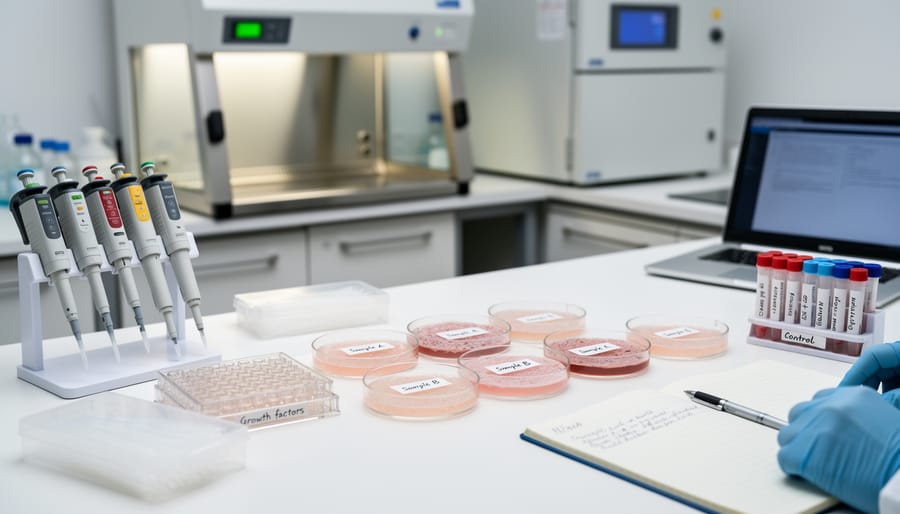
Researchers usually start with cell cultures, known as in vitro work, where cells grown in a dish are exposed to a compound under tightly controlled conditions. This approach is well suited to narrow, mechanistic questions. Does a peptide change how fast cells migrate across a scratch in the dish? Does it alter signalling activity or the expression of particular genes? Because variables are limited, results are quick to generate and easier to repeat. The trade-off is context. A dish has no blood supply, immune response, or surrounding tissue, so a cell behaving a certain way says little about what happens in a living body.
Animal studies, or in vivo work, fill part of that gap. A common design creates a standardized injury, such as a severed tendon or a damaged muscle, then compares treated animals with untreated controls. Outcomes might include tissue strength, measured healing, or microscopic structure. These models capture whole-system effects, including circulation and inflammation, that cell cultures cannot.
Yet animal results carry their own limits. Species differ in metabolism, healing speed, and dosing response, and a lab-induced injury is cleaner than the messy, repetitive strain behind most human injuries. A promising result in a rodent is a hypothesis for further testing, not evidence that a person would see the same outcome. Treating the two model types as complementary, rather than interchangeable with human data, is the sound way to read this research.
From Raw Observations to Reported Findings
Every published result starts as a pile of raw observations. In a tissue repair study, that might be tendon measurements, tissue images, and biochemical readouts, each logged against a specific animal, date, and protocol. The first quality checkpoint is capture. If a measurement isn’t recorded consistently, or can’t be tied back to its experimental conditions, everything downstream is weakened.
Next comes statistical analysis. Researchers compare treated groups against controls and test whether any difference is larger than chance would explain. Good practice means deciding on the analysis plan before looking at the results. Choosing the method afterward, to find a favourable outcome, is a well-known source of misleading findings.
Peer review then puts the work in front of independent experts who question the design, the statistics, and the conclusions. It’s a useful filter, but it isn’t a guarantee. Reviewers usually see summarized data, not the full records.
Replication is the real test. When a different lab repeats the work and gets a similar result, confidence grows. When it can’t, the original finding deserves caution.
Documentation matters most at the first and last steps: capturing data cleanly and keeping an auditable trail. That’s where secure, well-governed research data systems earn their place, because versioned storage, access controls, and reliable backups let a team show exactly how a reported number was produced.
Where the Research on These Peptides Stands

Most of what has been reported on the compounds commonly grouped into the Wolverine Stack, typically BPC-157 and TB-500, comes from preclinical work. That means cell cultures and animal injury models, where researchers look at tendon, muscle, ligament, or gut tissue after a controlled injury. These studies can suggest a mechanism worth investigating. They can’t tell us how a compound would behave in a person.
Human clinical evidence is a different story. It is limited, and what exists is generally small in scale or early in design. Large, well-controlled human trials, the kind that establish whether something works and whether it is safe at a given exposure, are not the foundation of this field. That gap matters, because a result in a rodent model often fails to carry over to people.
Regulatory status follows the same pattern. As far as the public record shows, health authorities have not approved these compounds as treatments for injuries. Status can differ by jurisdiction and can change over time, so any summary, including this one, is only a snapshot.
For that reason, don’t rely on secondary summaries or marketing copy to understand where things stand. Go to the primary literature and the official databases instead:
– Peer-reviewed studies in indexed journals, read for study type, sample size, and stated limitations
– Registries of clinical trials, to see what human research is actually underway or completed
– Regulator resources, such as Health Canada, for current approval and safety communications
Treating preclinical findings as hypotheses, and checking them against the primary record, is the habit that protects readers from overstated claims.
How to Evaluate Claims About Research Peptides
Claims about research peptides tend to arrive polished, which makes a repeatable checklist more useful than gut instinct. The same discipline applies to a vendor’s performance claim or an analyst’s market forecast: check the source before you trust the conclusion.
Start with the study type. A result from a cell culture or a rodent injury model answers a narrow question, and it rarely predicts what happens in a person. Then look at the scale and the controls. Small samples, missing control groups, and unreported methods all make a finding harder to trust, however confident the summary sounds.
Here are the questions worth asking of any claim:
- Was this a human study or an animal or cell study?
- Was it peer-reviewed and published in a credible journal?
- Is the sample size clearly reported?
- Has an independent group replicated the result?
- Who funded the work, and do they stand to gain?
- Is the source also selling a product?
The last two questions matter more than they seem. A seller can quote real studies accurately and still present them in a way that favours a sale, so conflicts of interest deserve a close look.
Finally, separate mechanism from outcome. Showing that a compound activates a pathway in a dish describes how something might work. It does not show that people heal faster or safer. Keep those two ideas apart and most overstated claims lose their force quickly.
Safety, Regulation, and Responsible Use of Research Information

When a peptide is sold “for research use only,” that label is more than fine print. It signals that the product is intended for laboratory work, not for people, and that it has not been through the review a medicine must clear before it is marketed for treating an injury. Suppliers of these compounds often sit outside the quality systems that govern pharmaceuticals, so purity, concentration, and sterility can vary from one batch to the next. Without independent testing, a buyer usually cannot confirm what a vial actually contains.
This matters because evidence from cell cultures and animal injury models does not translate neatly to people. Animals differ in dose response, metabolism, and healing biology, and a model typically tests one narrow question under tightly controlled conditions. A finding that looks promising in that setting says little about the right amount, the long-term effects, or how a compound interacts with someone’s existing health conditions or medications. Self-experimentation removes the monitoring, informed consent, and safety oversight that human studies are built around.
Regulatory status also differs by jurisdiction and can change over time, so what is permitted or restricted in one country may not hold in another, or next year. Treat any summary, including this one, as a starting point rather than current guidance.
If you are curious about these compounds or managing an injury, a licensed healthcare professional is the right first conversation. For current Canadian guidance, consult Health Canada’s resources directly rather than relying on supplier claims or secondhand summaries.
Why Research Data Infrastructure Matters to Life-Science Teams
Every finding discussed in this article starts life as a row in a spreadsheet, an instrument export, or a lab notebook entry. If that data is lost, altered without a record, or stored carelessly, the finding loses its value, however promising it looked. That is why research data infrastructure deserves attention from anyone who funds or relies on life-science work.
A dependable setup covers several practical needs. Experimental data needs secure, access-controlled storage so that only authorized people can view or change it. Analysis workloads, such as processing imaging or running statistics across large datasets, need enough compute to finish in a reasonable time. Backups and audit trails let a team show what was recorded, when, and by whom, which supports reproducibility and review. Compliance-minded handling matters too, since research environments often operate under institutional, contractual, and privacy obligations.
Resilience is part of the same picture. Planning for outages is cheaper than recovering without a plan, and understanding disaster recovery costs against the price of downtime helps teams budget sensibly. It also helps to know the disaster recovery vs continuity distinction, because restoring data and keeping research running are related but separate goals.
Omnicron is a Canadian IT provider that designs customized solutions around an organization’s actual workflows rather than a one-size-fits-all package. We work with technology partners including Cisco, HPE, and IBM, and we match platforms to the requirements of each environment.
Common Questions About the Wolverine Stack and Tissue Repair Research
Readers tend to ask the same handful of things about this topic, so the answers below stay short and point you to better sources where it matters.
What is the Wolverine Stack?
It is an informal nickname, not a scientific or pharmaceutical term, usually applied to a combination of research peptides such as BPC-157 and TB-500. The exact components vary depending on who is using the phrase.
Is it approved as a treatment?
These compounds are investigational and are generally labelled for research use only. Regulatory status differs by jurisdiction and can change, so check current Health Canada resources and speak with a licensed healthcare professional rather than relying on a summary.
What is the difference between animal-model and human evidence?
Animal and cell studies show whether a mechanism or effect is plausible under controlled conditions. They cannot confirm that the same result will occur, or be safe, in a person.
Where can I find reliable research?
Start with peer-reviewed journals, clinical trial registries, and regulatory databases, and read the original studies instead of marketing pages. Look at the study type, sample size, and any conflicts of interest before drawing conclusions.
The same habits apply well beyond peptides. Judging a claim by its source, its method, and its data is a skill decision-makers use whenever a vendor or a report makes a bold promise. Even the way a page earns visibility online is worth questioning, which is why we have written about reliable SEO techniques that rely on substance rather than hype.
Data quality matters because a finding is only as trustworthy as the records behind it. Clear documentation, proper controls, and well-governed storage let other researchers check and repeat the work. When those pieces are missing, even an impressive-sounding result deserves caution.
The “Wolverine Stack” is an informal nickname, not a formal scientific or pharmaceutical designation. It usually refers to research peptides such as BPC-157 and TB-500, studied in cell cultures and animal injury models. Those models are valuable because they let researchers control variables and test mechanisms. But they are also limited, since a result in a lab dish or a rodent does not guarantee the same outcome in a person.
Treat findings in these models as a starting point, not a verdict. Check the source, the study type, the sample size, and any conflicts of interest before accepting a claim. Anyone considering these compounds should speak with a licensed healthcare professional and consult Health Canada for current guidance.
The same discipline applies to the systems behind the science. Evidence-driven decisions depend on secure, well-governed, reliably stored data. If your team is building or modernizing research infrastructure, Omnicron’s team is ready to talk through what a dependable, tailored solution could look like.