

Establishing professional digital communication standards requires a three-part framework: clear channel protocols, response-time expectations, and documentation practices that protect both individuals and the organization. Most workplace communication breakdowns stem not from technology failures but from undefined norms around when to email versus message, how quickly teams should respond, and what level of formality each platform demands.
Canadian organizations that implemented structured digital communication policies in 2025 reported 34% fewer internal miscommunications and measurably improved project completion rates. The difference between high-performing teams and those struggling with digital overload often comes down to whether leadership has codified expectations or left employees to guess at appropriate practices.
Digital workplace etiquette extends beyond politeness. It determines whether urgent requests reach the right person through the right channel, whether asynchronous teams maintain productivity across time zones, and whether your organization’s communication records withstand legal or compliance scrutiny. A marketing manager sending a Teams chat for what should have been a documented email creates risk. An executive expecting instant responses to non-urgent messages creates burnout.
The challenge intensifies as hybrid work models persist and communication tools multiply. Email, Slack, Microsoft Teams, video conferencing, project management platforms, and internal social networks each serve distinct purposes, yet many workplaces treat them interchangeably. This guide provides IT managers and business leaders with a step-by-step implementation process for building communication standards that improve efficiency, reduce friction, and scale with organizational growth. You’ll learn which tools suit which communication types, how to set realistic response expectations, and how to verify that your policies actually work in practice.
Essential Tools and Platforms for Professional Digital Communication

Professional digital communication in 2026 relies on an interconnected ecosystem of platforms, each designed for specific interaction types. Understanding which tool serves which purpose eliminates confusion, reduces message overload, and establishes the foundation for respectful workplace communication.
Email remains the standard for formal communications, policy announcements, external correspondence, detailed project summaries, and anything requiring a permanent record. Its asynchronous nature makes it ideal for non-urgent matters where recipients need time to digest information and craft considered responses.
Instant messaging platforms like Microsoft Teams and Slack have become the backbone of day-to-day collaboration. These tools excel at quick questions, status updates, and informal team coordination. They support threaded conversations that keep discussions organized and searchable. However, they demand clearer boundaries than email: messages sent outside working hours can feel intrusive unless your organization has established norms around notification settings and response expectations.
Video conferencing platforms, Zoom, Teams, Google Meet, serve meetings that benefit from visual cues and real-time interaction. They’re essential for complex discussions, team building, and situations where tone and body language matter. The integration of remote desktop tools during technical troubleshooting sessions demonstrates how modern platforms extend beyond simple face-to-face conversation.
Project management systems like Asana, Monday, or Jira centralize task-related communication, keeping project updates separate from general chatter. This separation prevents critical deadlines from drowning in chat noise.
Internal social networks and knowledge bases serve as repositories for company culture, documentation, and announcements that don’t require immediate action.
The key to effective digital etiquette starts with channel selection. Choosing the right platform signals respect for colleagues’ time and attention. Integrated IT infrastructure ensures these tools work together seamlessly, allowing information to flow between systems without forcing employees to context-switch constantly or repeat themselves across platforms.
Common Pitfalls and What Not to Do
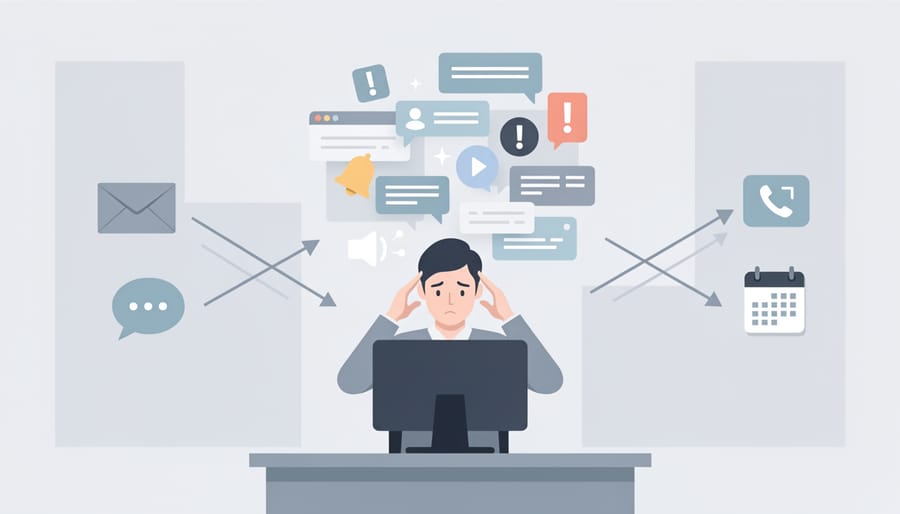
Professional missteps in digital communication create ripple effects that extend far beyond a single awkward message. When employees repeatedly violate basic communication standards organizations face measurable consequences: delayed projects, disengaged teams, and fractured working relationships that undermine collaboration.
Sending emails or messages late at night without providing context ranks among the most common violations. A Slack notification at 11 PM creates unnecessary stress for the recipient, who can’t determine whether the matter demands immediate attention or can wait until morning. IT managers should implement policies that discourage non-urgent communications outside standard hours or require senders to explicitly state expected response timing.
Equally damaging is the reflexive use of “reply all” when responding to group emails. This practice clogs inboxes with irrelevant messages and trains employees to ignore mass communications, creating blind spots when genuinely important information arrives. The same principle applies to unclear subject lines that force recipients to open messages just to determine relevance.
Failing to respect “do not disturb” settings or availability indicators demonstrates a lack of consideration that corrodes workplace culture. These digital boundaries exist for a reason, focus time, meetings, personal emergencies, and overriding them signals that your needs supersede everyone else’s.
Accessibility violations represent both a cultural and legal risk that Canadian organizations cannot afford to ignore. Sending images without alt text, using colour as the sole indicator of meaning, or sharing video content without captions excludes colleagues with disabilities and potentially exposes the organization to compliance issues.
Step-by-Step Framework for Implementing Digital Communication Standards

Step 1: Assess Your Current Digital Communication Environment
Start by mapping every digital communication tool currently in use across your organization. Don’t limit yourself to officially sanctioned platforms, shadow IT tools like personal messaging apps or unauthorized file-sharing services often reveal gaps in your formal infrastructure. Create an inventory that includes email systems, instant messaging platforms, video conferencing software, project management tools, and any collaboration spaces employees actually use daily.
Next, gather quantitative data on communication patterns. Pull metrics from your existing systems: average email response times, message volume by channel, meeting frequency and duration, after-hours communication rates. Your IT team can extract this data without compromising individual privacy by focusing on aggregate trends rather than personal usage.
Survey employees across departments and seniority levels to identify pain points. Ask specific questions: Which channels cause confusion? Where do messages get lost? What communication habits frustrate them most? Anonymous surveys yield more honest feedback about leadership communication styles and departmental silos.
Compare your findings against industry benchmarks for your sector. Canadian technology associations and professional networks publish standards for response expectations, meeting protocols, and channel usage that can guide your baseline. Schedule a consultation with your IT infrastructure team to assess whether current platforms support the etiquette standards you’ll eventually implement.
Step 2: Define Clear Channel Guidelines and Response Expectations
Once you’ve assessed your environment, translate findings into a decision-making tool that removes ambiguity. Create a channel matrix that assigns communication types to specific platforms, for example, urgent system alerts through Slack direct messages, project updates in dedicated Teams channels, formal policy announcements via email, and quick clarifications in thread replies. This mapping prevents the confusion that arises when employees receive the same message across three platforms and don’t know which to monitor.
Define response-time expectations for each channel. Email might warrant replies within 24 business hours, while instant messages require acknowledgment within two hours during work periods. Distinguish between “seen” and “substantive response” to manage expectations realistically. For distributed teams across Canadian time zones, particularly when coordinating between Pacific and Atlantic regions, specify core collaboration hours when immediate responses are expected, and establish protocols for marking messages as “urgent” versus “when you’re available.”
Document escalation paths: if a Slack message goes unanswered for X hours, the sender escalates to email and copies a manager. If email fails, phone contact becomes appropriate. Publish this matrix in accessible locations and reference it during onboarding. Clear guidelines eliminate the anxiety of choosing the wrong channel and the inefficiency of duplicating messages across platforms.
Step 3: Establish Email and Messaging Best Practices
Email and messaging form the backbone of workplace communication, so establishing clear standards here prevents confusion and wasted time. Start with subject lines: they should be specific, actionable, and under 60 characters to display properly on mobile devices. “Q3 Budget Review, Action Required by Friday” works; “Important Meeting” doesn’t.
For greetings, match formality to your recipient and context. External stakeholders typically warrant “Dear Ms. Chen,” while internal team messages can use first names. When in doubt, err slightly formal, you can always adjust down based on the response you receive.
Keep messages concise. If your email requires more than three scrolls on a mobile screen, it’s too long. Break complex information into bullet points, attach detailed documents separately, and front-load your request or key point in the first two sentences.
Attachment protocols matter: never send files over 10MB via email without compression or cloud links. Name files descriptively (“2026_Q3_Marketing_Budget.xlsx” not “Document1.xlsx”) and reference attachments explicitly in your message body.
Tone calibration is critical in text-based communication. Read your message aloud before sending. Remove phrases that could read as curt or passive-aggressive. Add brief context for requests to avoid seeming demanding.
Finally, standardize signatures across your organization: name, title, contact information, and any required legal disclaimers. Mobile signatures can be abbreviated but should still include essential contact details.
Step 4: Set Meeting and Video Conference Protocols
Video meetings demand structure to prevent chaos and wasted time. Begin with scheduling discipline: send calendar invites at least 24 hours in advance with a clear agenda and any pre-read materials attached. The agenda should list topics, time allocations, and desired outcomes so participants arrive prepared.
Camera expectations depend on meeting type. Strategic discussions and client-facing calls typically require cameras on, while large team updates may permit cameras off. Establish a default for your organization and communicate exceptions clearly in each meeting invite.
Backgrounds matter for professionalism. Neutral virtual backgrounds work well, but avoid distracting animations. If using your actual space, ensure it’s tidy and free of confidential materials visible on whiteboards or desks.
Mute protocols are non-negotiable: join muted by default, unmute only when speaking. In large meetings, assign a moderator to manage mute settings.
Recording policies must be explicit. Always announce at the start when recording, obtain consent where legally required, specify who can access recordings, and set retention periods. Your collaboration platform should automate consent prompts and secure storage.
Step 5: Train Teams and Integrate into Onboarding
The most effective digital communication standards fail without consistent training and cultural reinforcement. Leadership must visibly champion the new guidelines, when executives model the behavior, adoption accelerates across all levels. Begin with an all-hands announcement that frames etiquette as operational infrastructure, not policing.
Your rollout should follow this sequence:
- Launch a pilot workshop with one department to refine training materials and gather feedback before company-wide deployment.
- Deliver interactive sessions covering channel selection, response expectations, and tone calibration with real workplace scenarios.
- Distribute quick-reference templates for emails, meeting requests, and status updates that employees can immediately apply.
- Embed etiquette modules into new-hire orientation so standards become part of company culture from day one.
- Schedule quarterly refreshers and share anonymized examples of excellent versus poor communication to reinforce learning.
- Measure training effectiveness through follow-up surveys and communication quality audits at 30, 60, and 90 days.
Make documentation accessible in your knowledge base and collaboration platforms where teams already work. Create channel-specific guides, a one-pager on Slack etiquette, another on email protocols. Assign department champions who can answer questions and model best practices daily. This distributed ownership prevents etiquette from becoming an abstract policy document that sits unread in a shared drive.
Role-Specific Etiquette Considerations
Digital communication expectations shift significantly across organizational levels, and a one-size-fits-all policy ignores the distinct responsibilities each role carries. Executives operate in a goldfish bowl where every message sets cultural precedent. When a CEO sends emails at 11 p.m. without clarifying that no immediate response is expected, teams interpret silence as an expectation to be always-on. Leadership must model healthy boundaries, using delayed-send features, explicitly stating “no rush” when messaging outside standard hours, and demonstrating that thoughtful async communication trumps performative responsiveness. Canadian workplace culture values accessibility, but executives who blur work-life boundaries risk burning out their teams rather than inspiring them.
Managers face the trickiest balancing act: they need to be available to their reports while protecting their own capacity and modeling sustainable work habits. Clear communication about availability windows, consistent use of status indicators, and transparent prioritization help managers avoid the trap of constant interruptions while maintaining trust. When delegating via digital channels, specificity matters, vague Slack messages create more work than they save.
IT teams carry a specialized burden: translating technical complexity into actionable guidance for non-technical colleagues. This means ditching jargon in favour of plain language, leading with business impact rather than technical specs, and structuring messages to answer “what does this mean for me?” before diving into root causes. A network outage notification that opens with expected resolution time and workarounds serves users better than one that leads with router configurations.
- Executives: Model boundaries, use delayed send, clarify urgency explicitly
- Managers: Set availability windows, provide context in delegation, respect team off-hours
- IT professionals: Lead with impact, avoid jargon, structure for non-technical audiences
- Frontline staff: Use appropriate channels for escalation, provide context when reaching up
Frontline employees navigating upward communication benefit from understanding escalation protocols and providing sufficient context when raising issues. A two-line message to a director without background forces unnecessary back-and-forth; a well-structured note that includes the problem, what you’ve tried, and a specific ask respects everyone’s time.
Measuring Success and Maintaining Standards
Effective digital communication etiquette requires ongoing measurement, not just initial implementation. Track concrete metrics like average email response times (aim for under 24 hours for non-urgent messages), meeting punctuality rates, and the ratio of scheduled meetings to ad-hoc interruptions. Employee satisfaction surveys should include specific questions about communication overload, clarity of channel guidelines, and perceived respect for boundaries. Many enterprise platforms provide analytics dashboards that aggregate this data without invasive monitoring of individual message content.
Establish quarterly reviews where IT managers, HR, and team leaders assess these metrics together. Look for patterns: Are certain departments struggling with response time expectations? Do remote employees report different experiences than on-site staff? Technology infrastructure that supports business continuity and disaster recovery planning often includes communication analytics that reveal bottlenecks and compliance gaps.
Create feedback mechanisms beyond annual surveys. Anonymous suggestion channels, monthly pulse checks, and open office hours with IT leadership help surface issues before they become cultural problems. As your organization scales, revisit channel guidelines and response expectations to ensure they still match operational reality. Standards that worked for 50 employees may need adjustment at 200. Continuous improvement means treating communication etiquette as a living framework, not a static policy document.
Frequently Asked Questions
How should employees handle after-hours digital communication without violating work-life boundaries?
The best approach is to establish organization-wide norms about when delayed sending is appropriate and when asynchronous communication is expected. Most modern platforms allow scheduling messages to arrive during business hours, which respects colleagues’ time while capturing thoughts when they occur. For genuinely urgent matters, clear escalation protocols, such as phone calls or designated emergency channels, prevent confusion and reduce the pressure to monitor all digital channels constantly.
What’s the right way to address generational differences in communication platform preferences?
Rather than forcing uniformity, acknowledge that different age groups bring valid communication strengths and meet in the middle. Younger employees often prefer quick, informal messaging while senior staff may default to formal email; successful organizations create guidelines that specify which channels suit which purposes rather than which generations should adapt. Training sessions that pair employees across age ranges to share platform expertise build mutual understanding and reduce friction.
How do etiquette standards differ between remote and hybrid workplace models?
Remote settings require more explicit protocols around availability indicators, video-on expectations, and written confirmation of verbal discussions, since you can’t rely on physical presence cues. Hybrid models need additional rules about inclusive meeting practices, ensuring remote participants aren’t sidelined, and consistent documentation so information doesn’t stay trapped in office conversations.
What should managers do when employees consistently violate communication etiquette standards?
Address violations as performance issues through private conversations that assume good intent first, since many breaches stem from lack of awareness rather than defiance. If patterns continue after coaching, tie etiquette adherence to formal performance metrics and escalate through standard HR processes.
Can you maintain an informal, collaborative culture while enforcing digital communication rules?
Absolutely, etiquette standards create the structure that allows informal culture to thrive without descending into chaos. The key is distinguishing between tone (which can stay casual and friendly) and process (which needs consistency), so teams can joke in Slack while still respecting response-time expectations and channel purposes.
These questions reflect real challenges that surface during implementation, and addressing them proactively in your policy documentation saves countless clarifying conversations later. Canadian workplaces, with their emphasis on consensus and respect, tend to navigate these nuances more smoothly when leadership openly discusses the trade-offs and invites input rather than imposing rigid rules without context.
Digital communication etiquette isn’t a soft skill relegated to HR handbooks, it’s operational infrastructure that directly impacts your bottom line. Organizations that standardize their communication practices see measurable improvements in project delivery times, reduced email volume, fewer meeting hours, and higher employee satisfaction scores. In 2026’s competitive talent market, professionals expect workplaces that respect their time and provide clear communication frameworks. Companies that deliver on these expectations retain top performers and attract candidates who value efficiency.
The technology exists to support professional digital collaboration at scale. Modern IT infrastructure can integrate communication platforms, enforce sensible defaults, and provide the analytics you need to refine your approach. But technology alone won’t change culture. Leadership must model the standards you’ve established, and training must be ongoing rather than a one-time checkbox exercise.
Canadian organizations have a distinct advantage here. Our workplace culture already emphasizes respect, collaboration, and inclusivity. Building digital communication etiquette that reflects these values creates environments where innovation thrives alongside professionalism. When your team can communicate clearly across channels, time zones, and departments without friction, you’re not just being polite, you’re removing barriers to productivity.
The right technology partner understands that seamless digital collaboration requires both robust platforms and thoughtful implementation. With committed leadership and proper infrastructure, your organization can establish communication standards that become genuine competitive advantages in how you work, innovate, and grow.