

Evaluate your current infrastructure’s ability to handle peak betting volumes during major sporting events, where platforms like 9d bet casino must process thousands of simultaneous transactions without latency. Gaming operations require sub-100ms response times and 99.99% uptime guarantees that traditional hosting environments struggle to maintain consistently.
Implement geographically distributed edge computing nodes to reduce latency for players across multiple jurisdictions while ensuring compliance with regional data residency requirements. This architecture enables real-time odds updates and instant bet settlement, critical differentiators in markets where milliseconds determine competitive advantage.
Deploy automated scaling mechanisms that anticipate traffic surges based on event schedules and historical patterns rather than reactive scaling that causes service degradation. Modern sportsbook infrastructure must seamlessly scale from baseline operations to 10x capacity within minutes when major events like championship games or tournament finals drive unprecedented user activity.
Integrate dedicated hardware security modules and encryption at rest protocols that meet gaming commission standards across multiple jurisdictions simultaneously. Canadian data centers offer strategic advantages for operators serving North American markets, providing compliance frameworks that align with both provincial gaming authorities and emerging federal regulations while maintaining proximity to key user populations.
Establish redundant payment processing pipelines with instant failover capabilities to prevent revenue loss during processor outages or network disruptions. Gaming platforms cannot afford transaction failures during high-stakes moments when customer acquisition costs are highest and brand reputation depends on flawless execution during peak demand periods.
The Performance Demands That Break Traditional Infrastructure
Peak Load Events: When Your Infrastructure Matters Most
When the Super Bowl kickoff approaches or the World Cup enters knockout stages, sportsbooks face a critical moment of truth. These peak events can generate traffic surges exceeding 500% of baseline levels within minutes, overwhelming traditional infrastructure that wasn’t designed for such rapid scaling. During the 2022 World Cup final, major betting platforms reported traffic spikes of over 1,000% in certain markets, with some operators experiencing partial or complete service degradation.
The financial implications are severe. Every minute of downtime during a major sporting event represents exponential revenue loss, as bettors abandon platforms and migrate to competitors. The cost of downtime during these critical windows extends beyond immediate lost wagers to include damaged reputation, regulatory scrutiny, and long-term customer attrition. Industry analysis suggests operators can lose between $100,000 to $500,000 per minute during peak events, depending on market size and event significance.
Modern cloud infrastructure addresses these challenges through elastic scaling capabilities and geographically distributed resources. By leveraging enterprise-grade server hardware configured for rapid resource allocation, operators can automatically scale computing power, database connections, and bandwidth in real-time. This ensures consistent performance whether handling 10,000 or 500,000 concurrent users, protecting revenue streams and maintaining competitive advantage when it matters most.

The Real-Time Data Challenge
Sportsbooks and casinos operate in an environment where milliseconds matter. Every second, platforms must simultaneously process live odds updates from multiple sporting events, track thousands of concurrent player actions, maintain accurate game states across numerous tables and machines, and execute secure payment transactions. A single NBA game, for instance, generates hundreds of betting options with constantly fluctuating odds based on real-time gameplay, while slot machines and table games require instantaneous response times to maintain player engagement and regulatory compliance.
This operational complexity demands distributed computing architecture capable of horizontal scaling. Traditional on-premises infrastructure often buckles under peak loads during major sporting events or promotional periods, leading to system slowdowns that directly impact revenue and player experience. Modern cloud solutions leverage distributed processing across multiple data centers, enabling platforms to automatically allocate computational resources based on real-time demand. This approach ensures consistent sub-second response times even when managing 50,000+ concurrent users during high-traffic periods.
The integration of cutting-edge technology, including containerization and microservices architectures, allows operators to isolate critical functions and scale specific services independently, maintaining optimal performance across all system components simultaneously.
Security and Compliance: Non-Negotiable Requirements

Multi-Jurisdictional Compliance Through Cloud Architecture
Gaming operators face increasingly complex regulatory landscapes as they expand across multiple jurisdictions, each with distinct data residency, privacy, and compliance requirements. Cloud infrastructure provides an architectural solution that traditional on-premises systems struggle to deliver: the ability to maintain completely separate, compliant data environments while managing operations from a unified control plane.
Modern cloud platforms enable operators to deploy region-specific instances that store and process customer data within jurisdictional boundaries. A sportsbook licensed in Ontario, New Jersey, and the United Kingdom can maintain three distinct data environments, each adhering to local regulations regarding data sovereignty, responsible gaming protocols, and financial transaction reporting. This segregation occurs at the infrastructure level, ensuring that customer data from one jurisdiction never crosses into another region’s systems.
The advantage extends beyond simple data separation. Cloud architecture allows operators to customize compliance controls, retention policies, and security configurations for each jurisdiction while still benefiting from centralized management dashboards, unified monitoring systems, and shared operational playbooks. IT teams can push updates, manage security patches, and monitor performance across all regions without compromising regulatory isolation.
This multi-jurisdictional capability proves particularly valuable for Canadian operators expanding into regulated provincial markets and international territories. Traditional infrastructure would require separate physical data centers, dedicated hardware, and isolated management systems for each jurisdiction—a capital-intensive approach that limits scalability. Cloud architecture transforms compliance from a deployment barrier into a configuration parameter, enabling faster market entry and operational efficiency across diverse regulatory environments.
DDoS Protection and Attack Mitigation
Gaming platforms face constant DDoS attack attempts, with threat actors targeting both revenue-generating moments like major sporting events and underlying infrastructure vulnerabilities. Traditional on-premises security solutions struggle to absorb volumetric attacks that can exceed hundreds of gigabits per second, making them impractical for most gaming operators to implement independently.
Enterprise cloud infrastructure delivers multi-layered DDoS protection through globally distributed scrubbing centers that analyze traffic patterns in real-time. These systems employ machine learning algorithms to distinguish legitimate player activity from malicious bot traffic, automatically routing suspicious requests away from core gaming systems. Canadian data center providers leverage partnerships with leading hardware manufacturers to deploy next-generation firewalls and intrusion prevention systems at the network edge, ensuring threats are neutralized before reaching application layers.
Advanced threat detection extends beyond simple traffic filtering. Cloud platforms continuously monitor for application-layer attacks targeting login systems, payment processing, and API endpoints—vulnerabilities specific to gaming operations. When attacks occur, automated mitigation protocols activate within seconds, maintaining platform availability while security teams investigate the incident.
The cost advantage becomes clear when comparing cloud-based protection to building equivalent capabilities internally. A comprehensive DDoS mitigation system requires specialized hardware, 24/7 security operations center staffing, and continuous threat intelligence updates. Cloud providers distribute these investments across their infrastructure, delivering enterprise-grade protection at a fraction of the cost. This approach integrates naturally with disaster recovery planning, ensuring gaming platforms maintain operational resilience against both technical failures and malicious attacks.
Cloud Infrastructure Components for Gaming Operations

Hybrid Cloud Approaches for Sensitive Workloads
Hybrid cloud architectures offer gaming operators a strategic middle ground, enabling them to maintain critical control over sensitive operations while capitalizing on cloud scalability for customer-facing services. This approach addresses the unique compliance and security requirements inherent to sportsbook and casino operations.
In a typical hybrid deployment, operators retain their most sensitive functions on-premise or in private cloud environments. This includes player databases containing personally identifiable information, financial transaction processing systems, and proprietary gaming algorithms that represent competitive intellectual property. By keeping these elements within controlled infrastructure, operators maintain direct oversight of regulatory compliance requirements and reduce exposure to potential breaches.
Meanwhile, cloud infrastructure handles the variable-demand aspects of gaming operations. Front-end applications, content delivery networks, and customer service platforms benefit from cloud elasticity, automatically scaling during major sporting events or promotional campaigns. This separation allows operators to optimize costs by paying for cloud resources only when needed, while maintaining fixed infrastructure for baseline operations.
The hybrid model particularly benefits Canadian gaming operators who must navigate provincial regulatory frameworks while competing in increasingly digital markets. Modern orchestration tools enable seamless integration between on-premise and cloud environments, ensuring real-time data synchronization and consistent user experiences across platforms.
When implementing hybrid architectures, operators should prioritize secure connectivity between environments through dedicated network links or VPN tunnels, establish clear data governance policies defining which workloads reside where, and deploy unified monitoring systems that provide visibility across both infrastructure types. This balanced approach delivers operational flexibility without compromising the control and security that gaming operations demand.
Edge Computing for Latency-Sensitive Operations
For sportsbooks and casinos operating in today’s competitive landscape, edge computing has become essential infrastructure for delivering the ultra-low latency experiences that bettors expect. While centralized cloud data centers provide robust processing power, they cannot overcome the physical limitations of data transmission across long distances. Edge nodes positioned closer to end users reduce network hops and dramatically cut response times—a critical factor when processing live in-game wagers where odds can shift within seconds.
In live betting scenarios, delays of even 100-200 milliseconds can result in stale odds being presented to customers or create arbitrage opportunities that expose operators to financial risk. Edge computing addresses this by distributing computation to regional nodes that process betting requests locally before synchronizing with central systems. This architecture ensures that bet validation, odds calculations, and transaction confirmations happen near-instantaneously, maintaining both user satisfaction and operational integrity.
Canadian sportsbook operators, particularly those serving geographically dispersed markets, benefit significantly from edge deployments that account for the country’s vast distances. Strategic placement of edge nodes in major metropolitan areas ensures consistent performance regardless of user location. These deployments must be carefully designed to meet the specific game server hardware requirements that support real-time gaming operations, including high-frequency transaction processing and rapid state synchronization.
Beyond latency reduction, edge computing provides resilience through distributed architecture. If connectivity to a central data center is disrupted, edge nodes can continue processing transactions autonomously, queuing updates for later synchronization. This fault-tolerant approach ensures uninterrupted service during network events—a non-negotiable requirement for operations where downtime directly translates to revenue loss and damaged customer trust.
Cost Optimization: Moving Beyond CapEx to Operational Flexibility
Scaling Economics: Paying for What You Actually Use
Traditional infrastructure planning forces operators into an uncomfortable choice: either overprovision servers to handle peak loads—wasting resources during quiet periods—or underprovision and risk system failures during critical moments. Cloud-based auto-scaling eliminates this dilemma entirely.
Modern cloud platforms continuously monitor system metrics like CPU utilization, memory consumption, and transaction volumes. When demand spikes—during major sporting events, weekend betting surges, or jackpot announcements—the infrastructure automatically provisions additional compute resources within minutes. Once activity normalizes, those resources deallocate automatically, ensuring you only pay for what you actually consume.
For sportsbooks, this capability proves particularly valuable given the dramatic fluctuations in user activity. A Monday afternoon might require minimal infrastructure, while a championship game drives traffic to ten times baseline levels. Auto-scaling handles these variations seamlessly without manual intervention or advance planning.
The financial impact becomes immediately apparent. Rather than maintaining constant peak capacity at full cost, operators typically reduce infrastructure expenses by 40-60% while simultaneously improving performance during high-demand periods. This efficiency extends beyond compute resources to storage, database connections, and content delivery networks.
Canadian providers bring additional advantages through proximity to North American markets, ensuring low-latency scaling operations that maintain consistent user experiences even during rapid resource allocation. Combined with integration of cutting-edge automation technologies, modern cloud infrastructure transforms variable demand from an operational challenge into a competitive advantage through precise resource optimization.
Implementation Considerations for Casino and Sportsbook Operators
Vendor Selection: Hardware Partnerships That Matter
Selecting the right hardware partners represents one of the most critical decisions when building cloud infrastructure for gaming operations. Unlike general-purpose computing environments, sportsbooks and casinos require partners who understand the unique demands of real-time wagering platforms, where milliseconds can impact user experience and revenue.
Established infrastructure providers like Cisco, HPE, and IBM bring decades of enterprise-grade reliability to gaming deployments. These manufacturers have proven track records in mission-critical environments where downtime translates directly to financial loss. Their hardware solutions offer the redundancy, performance consistency, and support frameworks that gaming operations demand around the clock.
What sets successful gaming infrastructure apart is working with partners who provide more than equipment—they deliver Canadian expertise and localized support. Gaming platforms operating in Canadian markets benefit from vendors who understand regional regulatory requirements, data sovereignty considerations, and the importance of rapid response times when issues arise.
Enterprise-grade hardware partnerships ensure access to advanced technologies such as high-throughput network switches capable of handling peak betting volumes, storage arrays optimized for transactional workloads, and server platforms designed for sustained high-performance computing. These components must work seamlessly together, which is why vendor selection should prioritize integration capabilities alongside individual component specifications.
Local support infrastructure matters significantly in gaming operations. When technical issues emerge during major sporting events or peak casino hours, having access to Canadian-based technical resources and spare parts inventory can mean the difference between minor disruptions and substantial revenue impact.
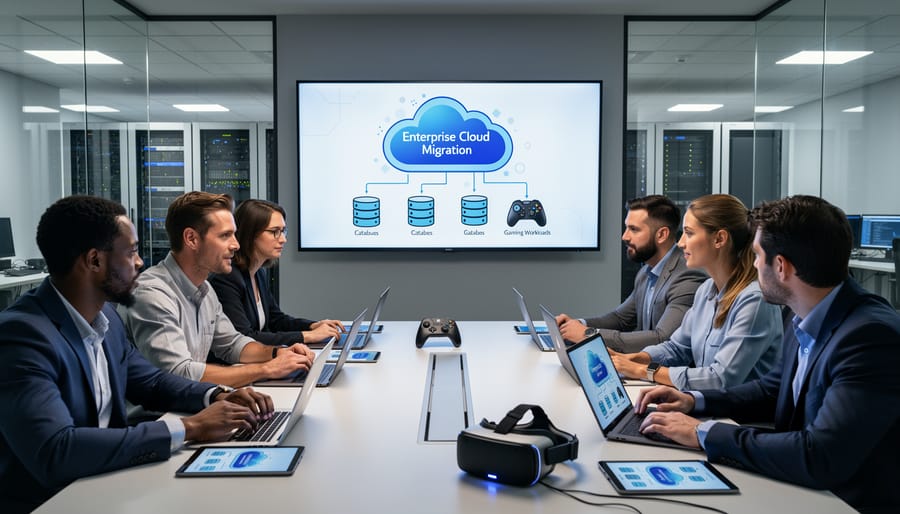
Migration Strategy: Minimizing Risk During Transition
For gaming operators, downtime translates directly to revenue loss and player dissatisfaction, making migration strategy critical to successful cloud adoption. A phased approach minimizes risk while maintaining operational continuity throughout the transition.
Begin with comprehensive environment assessment and dependency mapping. Document all systems, integrations, and data flows to identify potential bottlenecks before migration begins. This groundwork enables accurate sequencing and resource allocation throughout the transition.
Implement a pilot phase by migrating non-critical workloads first, such as reporting systems or internal tools. This approach validates your migration procedures and infrastructure configuration without exposing revenue-generating operations to risk. Monitor performance metrics closely during this phase to establish baseline comparisons.
For production systems, adopt a parallel running strategy where legacy and cloud environments operate simultaneously. This redundancy allows real-time validation of cloud performance while maintaining the ability to route traffic back to existing infrastructure if issues arise. Configure automated failover mechanisms to ensure seamless transitions between environments.
Establish rigorous testing protocols including load testing that simulates peak betting periods, security penetration testing, and disaster recovery drills. Canadian expertise in regulated gaming environments proves particularly valuable here, as compliance requirements demand documented testing procedures and audit trails.
Develop detailed rollback procedures with clearly defined trigger points and responsibility assignments. Every migration phase should include predetermined criteria for proceeding versus reverting, ensuring quick decision-making under pressure. Schedule migrations during historically low-traffic periods when player activity naturally decreases, providing additional safety margins.
Maintain constant communication between technical teams, business stakeholders, and support staff throughout the process, ensuring everyone understands their role in preserving business continuity.
The gaming industry’s competitive landscape has fundamentally shifted, making cloud infrastructure an essential component rather than an optional upgrade for sportsbooks and casinos. Organizations that delay modernization risk falling behind competitors who can deliver faster transaction processing, real-time betting experiences, and seamless scalability during peak events. The question is no longer whether to adopt cloud solutions, but how to implement them strategically while maintaining the security, compliance, and performance standards that gaming operations demand.
Success in this transition requires more than selecting the right technology stack. It demands partnership with IT solution providers who understand both the technical complexities of cloud infrastructure and the unique operational requirements of the gaming industry. From handling microsecond-level latency requirements for live betting to ensuring regulatory compliance across multiple jurisdictions, these specialized considerations require expertise that bridges infrastructure knowledge with gaming-specific insights.
Canadian expertise in cloud solutions offers particular advantages for organizations prioritizing data sovereignty, regulatory compliance, and reliable infrastructure partnerships. Working with providers who combine cutting-edge technology integration with proven hardware partnerships ensures your infrastructure can support both current operations and future growth.
We invite you to schedule a comprehensive assessment of your current infrastructure and explore how tailored cloud solutions can provide the competitive advantage your operation needs. Our consultation process examines your specific requirements, operational challenges, and growth objectives to develop a strategic roadmap that aligns technology investment with business outcomes.